
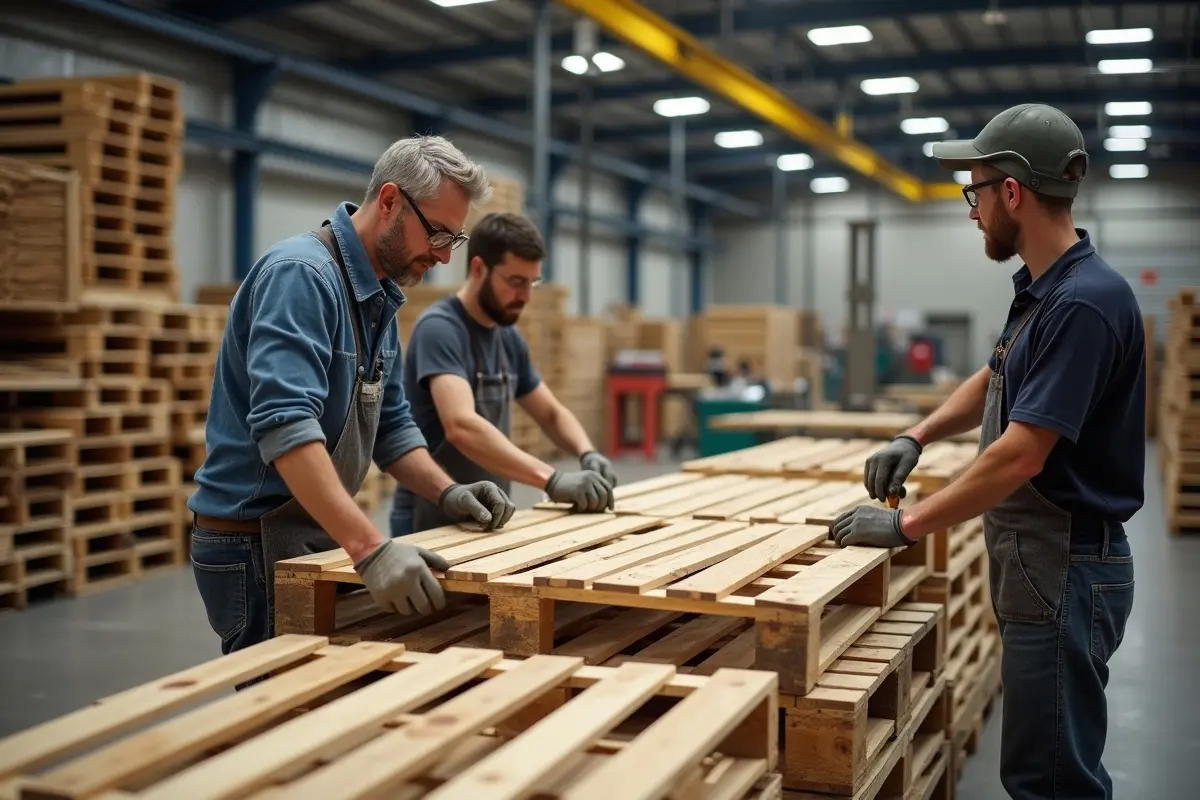
Wood is the main material used in approximately 90% of the 2 billion pallets estimated to be in circulation in the U.S. (National Wooden Pallet & Container Association / Modern Materials Handling). That same percentage of wood pallets in use today is estimated to have existed since the 1980s, and in the face of plastic aggressively marketing itself as the better alternative, the plastic to wood pallets ratio is still less than 1%. Most of those plastic pallets are used in closed-loop systems. That’s not inertia. That’s evidence of wood winning on cost, repairability, sustainability, and availability every time somebody takes the time to do the math rather than just listening to a sales pitch.
When standard stock pallets stop being the practical option
Standard 1200×1000 pallets exist because most freight fits them well enough, and for a lot of businesses, that’s genuinely fine. The problem shows up when freight doesn’t fit that profile – irregular dimensions, concentrated point loads, drums or coils that need non-standard deck spacing, or racking systems that demand a specific reinforced stringer configuration a stock pallet was never engineered to provide.
That’s the point where sourcing Custom Pallets in Melbourne stops being a nice-to-have and becomes the only sensible move. A specialist fabricator takes the actual load specification – weight, shape, handling method, racking requirements – and builds to that spec directly, rather than forcing the freight to conform to a generic pallet footprint. It’s a more direct route to a pallet that actually performs, instead of a stock unit that technically works but leaves risk on the table every time it’s handled.
The plastic sustainability myth, examined
Plastic pallet suppliers have developed a strong argument around hygiene and moisture resistance, and it’s accurate – plastic does not absorb spills, does not splinter, and does not require heat treatment for pest control. However, the sustainability case is where plastic pallets fall short. They are manufactured from petroleum-based resin, and when they crack or fail, they are either downcycled into lower-grade products or disposed of in landfill. A broken HDPE pallet does not have a viable second life on most premises.
Timber does not suffer this issue. A damaged deck board is swapped out. A cracked stringer is replaced. When a timber pallet ultimately passes its use-by date, it is chipped into mulch, processed into biomass fuel, or remanufactured into particleboard. The loop is closed. According to the Australian Packaging Covenant Organisation (APCO) frameworks, this reclaim does more heavy lifting than a marketing statement in relation to how much recycled plastic is in the product because that’s the waste stream in which businesses are required to show responsibility.
Then there is the carbon story, which plastic can’t compete with. Timber is the sole pallet substrate that sequesters carbon throughout its useful life, instead of releasing it during manufacture. A tree harvested from a correctly managed FSC or PEFC plantation has already sequestered carbon, and that carbon remains locked inside the wood fibre until the pallet is broken down. A carbon cost is incorporated from the time a plastic pallet is extruded, and it’s in the red the whole time.
Repair economics plastic can’t match
Here’s something that many procurement discussions overlook: a wooden pallet can be repaired on the spot using a hammer and a few nails. On the other hand, a plastic pallet with a cracked runner is essentially unusable since it’s not feasible to weld structural plastic in a cost-effective manner in a warehouse. This single difference changes the cost-per-trip assessment for open-loop supply chains in which pallets are not re-entering a pooling system like Loscam or CHEP.
If your pallets are sent out with products and remain with the customer, you are not spreading the cost of an expensive plastic unit over an unknown number of trips. Instead, you’re writing off a relatively low-cost wooden pallet per trip, and that math holds up especially well for exporters or single-use supply chains that do not have pallet return programs.
Why custom fabrication is where timber actually separates itself
Plastic pallets originate from injection molds, and molds are expensive to design and often more so to modify. Once a manufacturer orders a mold, a pallet’s dimensions, deck spacing, and stringer configuration are set for that tooling’s whole tenure. Steel pallets have a similar rigidity issue – custom welding jobs are slow and expensive in large quantities.
Timber doesn’t suffer the same constraint. A fabricator can cut joists to odd lengths, add perimeter boards for edge protection, adjust nail placement to effectively concentrate strength under a known load point, or swap between captive and non-captive stringer designs based on how the pallet will be handled. None of that requires new tooling. It just requires a saw, a jig, and someone who understands the load profile.
This flexibility is why niche freight – coils, drums, oversized machinery, irregular-shaped components – almost always ends up on a custom timber build rather than a stock plastic unit pulled off a shelf.
Load ratings aren’t one number
Many buyers make the all-too-common mistake of assuming “load capacity” is a single number. It’s not, and treating it as such is a recipe for racking failures. There are three separate engineering metrics:
1. Static load is the weight the pallet can hold without moving, when it’s entirely supported on the floor.
2. Dynamic load is the weight the pallet can hold while in transit on a forklift or pallet jack.
3. Racking load is the weight at which the pallet fails when stored on racking beams, relying entirely on the bottom deck boards and stringers for its structural integrity.
A pallet made for maximum static loading in a warehouse isn’t necessarily the best pallet for use in a racking system. With custom manufacturing, a business can provide the details of the intended use to ensure a pallet’s deck boards are properly spaced, stringers are the correct depth, and additional reinforcement is included to match the racking load.
ISPM 15 and staying export-ready
Any wooden pallet that crosses an international boundary must meet ISPM 15, the international phytosanitary standard for wood packaging’s requirement for treatment to kill pests in the wood. It’s quite explicit: processing raw wood with heat to a minimum core temperature of 56°C for a minimum of 30 minutes, after which the completed pallet is marked with the approved HT stamp.
Methyl bromide fumigation was an approved treatment process, but since it is an ozone-depleting gas, it has been largely eliminated as an approved treatment in most geographies. This has the effect of making heat treatment the most available and practical treatment method. The implication for custom builds is that compliance must be built in from the start; any raw, untreated wood, no matter how well it is machined, gets rejected or fumigated at the border, rendering the entire exercise of trying to export via a pallet moot. Large, reputable fabricators include HT certification as a part of their complete assembly.
Hardwood or pine – it’s a cost-performance call, not a quality one
Australian hardwoods such as eucalyptus and ironbark are denser, stronger, and resistant to more abuse than radiata pine and therefore far more durable and longer-lasting in aggressive applications. The downside is the cost and weight. They are considerably more expensive to produce and significantly heavier than pine so the cost of freight over the life of every pallet is much higher with hardwood.
Radiata pine, on the other hand, is lighter, cheaper, and much easier to saw, nail, and sand. It’s perfect for high-volume production runs and extremely cost-effective to repair and recycle. If you’re moving large volumes of moderately heavy product then the tare weight of your pallets for the truck, ship, or air freight will quickly become a major proportion of your overall shipping costs and pine is the no-brainer choice. If you’re moving extremely heavy, dense, or abrasive product and the cost of product damage as a result of pallet failure multiplies the cost of a pallet by ten or even one hundred times then the marginal cost of a pine pallet starts to look like extremely poor value.
Moisture control is where quality builds separate from bad ones
Kiln drying is not optional if you need a pallet to be effective. Green or partially dried wood still holds enough moisture content (MC%) to warp as it continues drying in use, and warped boards loosen the nail joints, create uneven load surfaces, and invite mold to grow during long sea transit or humid warehouse storage. A pallet that looked good on the dock may arrive at its destination structurally compromised because the wood was not dried properly before assembly.
This is also directly related to dimensional accuracy, which is more important than it used to be now that automated storage and retrieval systems (ASRS) are common in modern warehouses. These systems expect pallets within strict tolerances, and a warped or swollen board throws that off. Manufacturers who are serious about quality use pneumatic coil nailers, jig-stabilized assembly, and in some cases CNC cutting to maintain consistent dimensions across the entire production run, in place of manual bin-pallet construction that varies from unit to unit.
Engineered wood alternatives are worth knowing, not worth switching to
Plywood and OSB are sometimes pitched as premium alternatives to solid timber boards for some uses where a flatter, more uniform product is required. They perform particular roles in specialized manufacturing, particularly where there will be regular product contact with surfaces. For general-purpose and heavy-duty builds, though, solid sawn timber, assuming proper kiln drying and the correct grade, remains more cost-effective and repairable than any of the engineered products, and this is why it is still the preferred material for anyone producing pallets at scale.
Timber’s advantage was never really about tradition. It’s about a material that can be cut, nailed, repaired, and fully recovered at end of life, all while being grown back through certified forestry practices that keep the supply renewable. Plastic and steel can match parts of that. Nothing matches all of it.


Leave a Reply
You must be logged in to post a comment.