
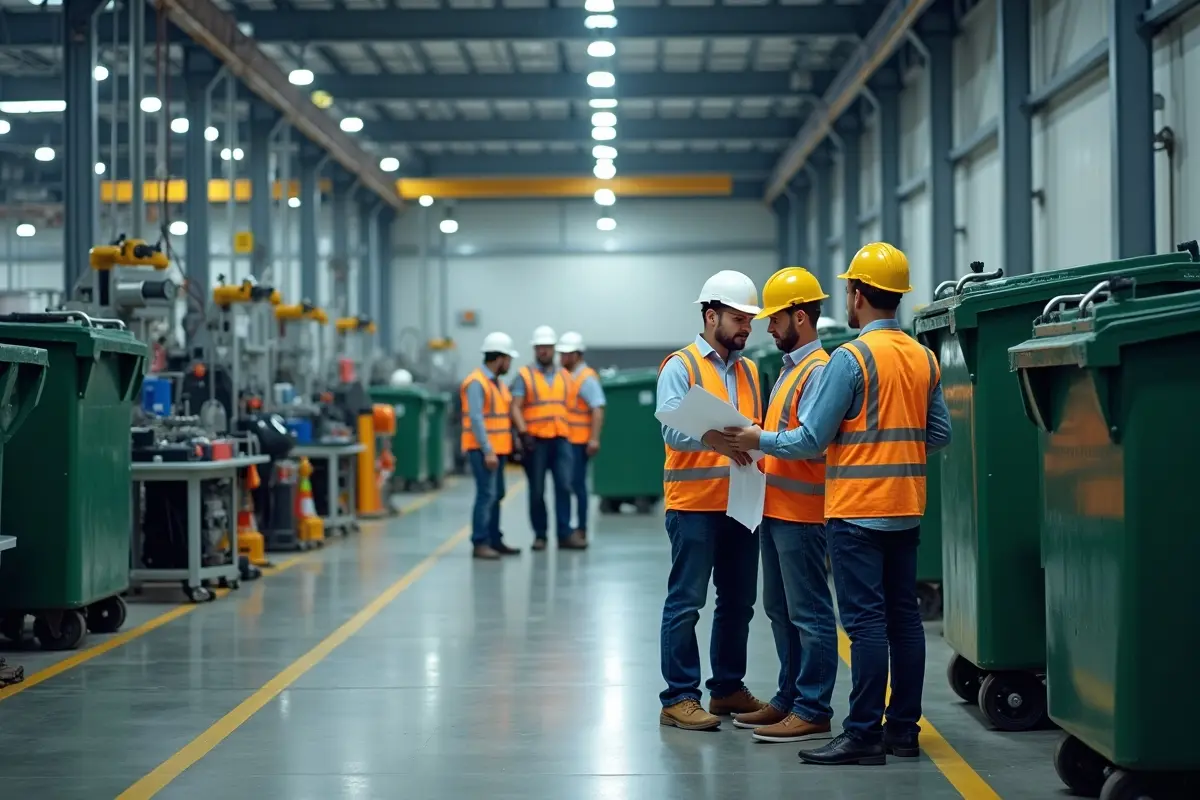
Waste reduction and management are crucial for manufacturers, but they’re also complex issues with multiple challenges. That’s why many industrial plants are turning to digital technology. By combining analysis of waste streams with the power of advanced analytics, companies can make the leap from managing waste to minimizing it.
Contents
- 1 Why waste management is a cost lever, not just a compliance checkbox
- 2 Start with a material flow analysis
- 3 Source separation is where the value is won or lost
- 4 Handling and transport costs are where margins get eaten
- 5 Integrate waste management into 5S methodology
- 6 Conduct formal waste audits on a fixed schedule
- 7 Understand your chain of responsibility
- 8 Industrial ecology and local symbiosis opportunities
- 9 Managing e-waste and restricted materials separately
Why waste management is a cost lever, not just a compliance checkbox
Most companies provide scrap-metal recycling strictly as a service. They pay a contractor to come in, pick up the material, and dispose of it. Those companies are getting a fraction of their scrap’s potential value. A meticulously organized and cleanly managed scrap-metal stream can generate returns similar to what a company would get if they sold the metal themselves, accounting for the contractor’s fee.
If they’re smart, manufacturers treat waste as a resource: some material in, quality product out. That extends to scrap-metal trading companies. They bring roll-offs as needed, pick up as scheduled, and check back with a new rolloff on a frequent and predictable basis. These companies will pay top dollar for cleanly separated, well-sorted metal scrap, either on a quoted “price to arrive” or a “price to pick up” basis. Scrubbing value out of the scrap stream requires a little extra labor to keep all aluminum, all stainless, and all types of steel separate.
Cores should be kept with cores, chips and turnings should be kept dry and separate, and contaminants like cutting fluid or other process residues should be minimal. Scraps trays can be color coded to encourage scrappers to separate meaningfully, and to cut down on the time spent sorting bins. Scrappers will load the roll-off with a forklift, others will pay you based on how much a dumpster they provide is filled, but all will pay for well-sorted metal.
Start with a material flow analysis
You can’t manage what you can’t see – and a material flow analysis (MFA) is the best way to map every raw material input against the finished product output and account for the difference. This tells you your waste – but more importantly, it tells you _where_ waste is occurring, not just how much.
In machining-heavy environments, this data can be very surprising. You might have a rough idea of how many tonnes of aluminum sheet you order each month, but the MFA will tell you that 14% of that material ends up as floor swarf, bin overflow, or contaminated mixed scrap – none of which is being recovered at full value. Without these detailed numbers, your waste management decisions are largely guesswork.
Run the analysis quarterly, because production volumes change, product mixes shift, and new processes are introduced. A baseline MFA that was accurate two years ago might not truly reflect the waste points in your process today.
Source separation is where the value is won or lost
The most frequent mistake in industrial scrap management is to mix different material grades. For example, once the valuable copper waste is contaminated by stainless steel scraps, the entire bin is declassified. Processors can still use this material, but the return per tonne decreases substantially. The loss directly impacts the profitability of the facility at every collection.
The solution is source separation – sorting waste at the point of generation – rather than combining it at a central collection point. For this, you require color-coded, well-marked bins at the machinery, and fabrication stations. Also, the bins must be near the generation point. If a worker has to walk more than a few steps to reach the container for aluminum off-cuts, the worker will likely drop the scrap in the closest bin.
The bin for ferrous metals is likely to see the most volume because most facilities send their scrap iron and steel to be immediately recycled. Conversely, non-ferrous scrap is often stockpiled due to the storage restrictions that result from careless mixing. Collected aluminum off-cuts are more likely to end up mixed with shavings of steel sharpening from the lathe unless the aluminum recycling stream is optimized.
Non-ferrous materials, which are less common in industrial refuse, take up an outsized share of space. This represents not only a lost recycling opportunity but a financial hit to the bottom line. Recycling aluminum brings several thousand dollars more per tonne than does recycling steel. So the scrap is cost-neutral, but as prices for virgin materials rise, the price for clean scrap also increases.
Handling and transport costs are where margins get eaten
One oversight we often see in the early stages of clients’ waste management planning is underestimating internal logistics costs. This includes the labor associated with moving scrap around the factory floor. Collecting material from workstations, consolidating in staging areas, and loading for external pick-up can add up to a real percentage of your total waste management overhead. It’s a number that few companies carefully track.
We see two easy adjustments that help here. One, map bin placement to production flow not space availability. When you place bins on a reactive short term basis wherever there is a bit of free floor space you will get unnecessary internal movement. Treat bin placement the same way you treat equipment placement. Two, low-density waste streams like thin sheet metal off-cuts and light gauge wire benefit significantly from compaction prior to transport. We know this obviously reduces volume and hence reduces both collection frequency and per-trip handling costs.
For manufacturing plants along major industrial corridors, using a specialist provider for scrap metal western sydney offers consolidated backloading schedules, entirely transparent weighbridge reporting and direct access to local circular economy loops with zero middlemen. A consolidated regional partner equals shorter transport distances, better weighbridge prices, and the peace of mind that comes from knowing exactly where your production scrap is heading.
Integrate waste management into 5S methodology
Facilities implementing lean manufacturing programs already possess the organizational structure to implement systematic waste management – often they just haven’t explicitly made the connection between the two. The 5S methodology (Sort, Set in order, Shine, Standardize, Sustain) almost directly corresponds to good industrial waste practice.
In terms of Sort, it’s not conducive to have excessive materials or scrap lying around workstations, and these practices could be translated to minimize waste generation. Set in Order could mean placing waste bins or areas in where they logically belong in the work process. Shine relates to keeping those areas clean, which could be essential for waste areas/containers where odorous, liquid, or dusty materials may cross-contaminate each other. It also becomes easier to identify waste containers/areas that are full if they’re not obscured.
Standardize could correspond to writing down these 5S waste management processes so they are consistently followed across shifts. Waste tends to be an issue dealt with at the last minute of a shift, or when a process deviates. Sustain means continuously auditing or checking the waste management methods to ensure that these practices do not get lost again against old habits.
Conduct formal waste audits on a fixed schedule
Waste management is not a one-and-done setup. You must adapt as processes, products, and waste streams change. New reclamation, recycling, or treatment opportunities and costs may develop. Ideal disposal options may become less available, more expensive, or less environmentally responsible – or new alternatives may emerge. Current vendors may become less reliable, while competitors may offer more attractive new services. Ideally, new, more stringent environmental compliance goals emerge for your business to seize competitive opportunity.
An important component of this strategic cycle is the waste audit. Instead of an isolated, superficial “look-around-and-make-a-list” event, we’re talking about a periodic deep dive into everything that’s left the facility as “waste.” The effort not only inventories what you’ve got, but also can track changes, make corrections, and fulfill due diligence. This is your strategic feedback loop.
A good waste audit also includes a systematic process review, training verification, and spotlight sifting on high impact, high-risk streams. For example, the full costs of oil-contaminated swarf disposal are generally 35-50% hidden as waste generation costs – that’s pure liability piling up in the dumpster if you’re not on your game.
Understand your chain of responsibility
Manufacturers are legally responsible for their waste after it leaves the door. The duty of care principle, which exists in virtually every industrial regulatory framework, dictates that responsibility for waste disposal remains with the generator until they are sure it has been transferred to an appropriately licensed carrier, and subsequently, a suitably licensed treatment or disposal facility.
In short, this means the facility is responsible for verifying that its waste contractor is properly licensed, and can provide tracking documentation from the point of collection to the point of treatment or final disposal. That paperwork acts as your insurance policy. Should a contractor cut corners and illegally dispose of material, the facility can be held liable for fines or negative press even if you were not consciously complicit in the act.
Request the licensing credentials from any new waste contractor and grill them about their processing chain for each waste type. If they are a legitimate processor who is sending material for further processing, they should be more than happy to provide those details.
Industrial ecology and local symbiosis opportunities
The driving philosophy behind what’s known as industrial symbiosis is straightforward: the heat that is wasted in one factory can be used to heat another, the ash that is left over in one process can be used in another, and the water used in one factory can be cooled and used in another.
The commercial benefits that can accrue from building an industrial ecosystem of businesses in close proximity to one another that use each other’s byproducts can add up quickly. Clean production Canada’s paper mills produce a waste sludge that most companies would have to spend money to dispose of. Yet it turns out to be the perfect component for making paper at another factory across the street.
It is the ink sludge and other waste generated by that process that another factory uses. Meaning that one factory’s cost is another’s revenue stream, while the water used in that second paper factory must be constantly cleaned and reused, which is done by a third factory, with waste heat from that factory being, in turn, used to warm greenhouses.
Managing e-waste and restricted materials separately
Not all waste generated by industry falls into the category of scrap metal and machined offcuts. Another frequently encountered waste stream is complex: e-waste. Sensors, printed circuit boards, wiring harnesses, and control systems are pervasive throughout industry, and all of them reach the end of their useful life with the potential for value recovery. Like scrap metal, the resource content of e-waste is real. The value of the copper alone in a printed circuit board might be 20 times the value of the steel scrap in a ton of swarf. But unlike scrap metal, e-waste is also hazardous waste, classified and managed under entirely separate regulations. Electronic waste contains noxious substances, including lead, cadmium, and mercury, and for that reason alone it cannot be disposed of as general waste.
But that doesn’t mean you should lump your facility’s retired control systems in with the scrap turnings. If you are managing industrial waste responsibly, your facility’s e-waste contractor will be different from your clean scrap contractor, and your e-waste disposal documentation will be separate from that of the empty drums from the machine shop.
E-waste value recovery
Facilitating e-waste value recovery in safety and compliance requires a different sort of downstream capability. If you are a producer of scrap e-waste, your contractor may need to separate grades for you, but it is important to realize this and to look for recycling partners who can handle that separation in post-processing.
One further distinction in industrial waste management is important to note. Sometimes a piece of scrap isn’t just a solid cylinder of clean brass without further qualification. If the piece is a previously used fixture that has been soaked in oils and coolants for the past 20 years, processing the copper out of it may still be resource recovery of a contaminated and therefore waste-rated component. Are there recapture values for you in trading the spent coolants to a re-refinery? Know what kind of waste it is before you put it in the bin.



Leave a Reply
You must be logged in to post a comment.